Heat pumps · UK · Guide
Heat pumps: a guide to the four types, grant and costs
Air source, ground source, air-to-air or hybrid: this guide covers the four kinds of heat pumps, which one fits your home, what the government pays towards it, and what it costs to run.
Key facts
- The Boiler Upgrade Scheme pays £7,500 towards an air source or ground source heat pump and £2,500 towards an air-to-air one in England and Wales.1
- Homes off the gas grid replacing oil or LPG get £9,000 until 31 March 2027.2,3
- Hybrid systems that keep a fossil-fuel boiler get no grant.3
- Ask for a 50°C design rather than 65°C: on a Cosy 6 that means a seasonal efficiency of 3.4 instead of 2.8, so each kWh of heat costs less.4
On this page
- How a heat pump works
- Do heat pumps cope with a British winter?
- The four kinds of heat pump
- Which heat pump suits which home?
- What does a heat pump cost to run?
- What a heat pump costs to buy
- Grants, VAT and loans
- From survey to warm radiators
- Finding an MCS installer
- Questions to ask before you sign
- When a heat pump is the wrong buy
- Our verdict
A heat pump moves heat that is already outside, in the air or the ground, into your home, using electricity to do the moving. For most British houses with radiators the right choice is an air source heat pump that heats water (air-to-water). Ground source suits homes with land and a bigger budget, air-to-air suits heating a few rooms, and a hybrid that keeps the gas boiler loses the grant. In England and Wales the Boiler Upgrade Scheme pays £7,500 towards air source or ground source and £2,500 towards air-to-air.1
Off the gas grid the offer is bigger: a leaflet promising £9,000 off a heat pump is going to 200,000 eligible homes in England and Wales, most of them rural households on heating oil.5
Our verdict: if you heat with oil or LPG off the gas grid, this winter is the moment, with an extra £1,500 off and zero rated VAT until March 2027.3,6 On mains gas, a heat pump is a good buy once the survey shows your radiators can run cool. The design work decides the running cost; the brand matters less.
How a heat pump works
Think of a fridge run backwards. A refrigerant soaks up heat from the outside air or the ground, a compressor squeezes it to a higher temperature, and that heat passes into the water in your radiators and cylinder. Both the Octopus Cosy and the Vaillant aroTHERM plus use R290, a natural refrigerant.4,7
The electricity runs the compressor and the fans; it does not make the heat. That is why a heat pump puts out several units of heat for every unit of electricity it uses. In real homes, Cosy systems run at a seasonal efficiency of about 3.6.4
Do heat pumps cope with a British winter?
They are rated for it. The output figures that matter are measured on a cold day: a Cosy 6 delivers 5.6 kW of heat with the air outside at −5°C and the water at 50°C, and all three Cosy models can heat water to 70°C.4 Sizing is what keeps a house warm in January, which is why the heat loss survey matters more than any brochure.
Most owners are content with the bills. In a survey of 2,837 Cosy customers three months after installation, 87% said their home cost the same or less to run.4
The four kinds of heat pump
| Type | What it heats | Grant (England and Wales) | Warm Homes Loan cap |
|---|---|---|---|
| Air source (air-to-water) | Radiators or underfloor heating, plus hot water | £7,500; £9,000 replacing oil or LPG off the gas grid | £20,0001,8 |
| Ground source (including water source) | Radiators or underfloor heating, plus hot water | £7,500; £9,000 replacing oil or LPG off the gas grid | £35,0001,8 |
| Air-to-air | Room air, through indoor units | £2,500, homes only | Not yet: no MCS standard to certify against1,8 |
| Hybrid (heat pump plus fossil-fuel boiler) | Radiators and hot water | none | none3 |
Loan caps apply before the grant comes off.8
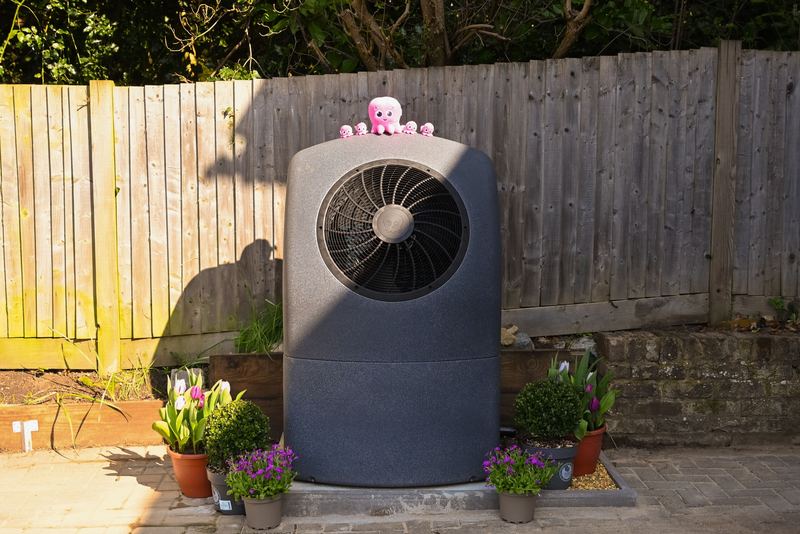
Air source is the default. A fan unit outside the house pulls heat from the air and passes it into the water in your heating system. Once the installer has applied, the grant voucher lasts three months.1 Our air source heat pump guide covers sizing, noise and models in detail.
Ground source draws heat from pipes buried in the garden or sunk into boreholes, and the grant also covers water source heat pumps and shared ground loops.3 Its grant voucher lasts six months, double the air source window.1 The higher loan cap tells you what to expect from the quote.
Air-to-air works like an air conditioner run in reverse, blowing warm air into rooms. It heats no water, and its grant applies only in homes.1
Hybrids pair a heat pump with a gas or oil boiler. There is no grant for a hybrid system, which changes the sums entirely.3
Which heat pump suits which home?
A gas-heated semi or terrace with radiators. An air-to-water heat pump sized from a room-by-room heat loss survey. Octopus, for example, matches its Cosy 6 to homes of one to four bedrooms with heat loss under 5.6 kW, and the Cosy 9 to three to five bedrooms up to 8.7 kW.4 Expect to change some radiators and add a hot water cylinder if you have a combi boiler now.
An off-gas home on oil or LPG. The strongest case of all. Air source or ground source both get £9,000 here, as long as the house has no mains gas and no record of a gas meter point, capped or clamped connections included.1 Ground source makes sense if you have the land and plan to stay for decades; otherwise air source is the simpler job.
A flat. Space outside is the constraint. The Vaillant aroTHERM plus comes in five sizes and starts at 3.5 kW, small enough for a home with low heat loss, while air-to-air needs only compact indoor units and a small outdoor fan.7 If you rent or own a leasehold flat, read your tenancy agreement or lease before anything goes on an outside wall.
A new home. From 24 March 2027, new homes in England will need low-carbon heating under the Future Homes Standard.9 Developers building new homes cannot claim the grant, but self-builders can for a heat pump.1
What does a heat pump cost to run?
The number to ask for is the seasonal coefficient of performance, or SCOP: how many units of heat the system delivers, over a year, for each unit of electricity. Divide your electricity price by the SCOP and you have the cost of each kWh of heat.
At the October to December 2026 cap, a system with a SCOP of 3.4 makes heat for a fraction of the electricity unit rate.10,4 Design the same Cosy 6 for 65°C water instead of 50°C and its SCOP drops to 2.8, so each kWh of heat costs more.4 The larger Cosy 12 is rated at 3.9 for a 50°C design, which makes its heat cheaper still at the same electricity price.4
Household electricity in Great Britain carries 0% VAT from 1 October 2026 to 30 June 2027.11 The capped price already reflects that.10 The cap changes every quarter, so put your own unit rate into our heat pump running cost calculator rather than relying on ours.
One more line on the bill: removing the gas supply altogether ends the gas standing charge too, though fewer than 3% of Cosy customers have gone that far.4 The rest still pay both standing charges.
What a heat pump costs to buy
Installed prices vary with the house more than the hardware. For a benchmark, Octopus’s typical Cosy price after the £7,500 grant was £4,064 for quotes between June and September 2026, against a national average of £5,408.4 The Cosy installation includes a free heat loss survey and, if you don’t already have one, a new hot water cylinder.4
Our air source heat pump cost guide breaks down what pushes a quote up and how the grant, VAT and loans fit together.
Grants, VAT and loans
Boiler Upgrade Scheme (England and Wales). The installer applies and takes the grant off your quote.1 You get one grant per property, and nothing towards replacing an existing low-carbon system.3 Installers must be MCS certified.2 The full rules, from who qualifies to what to sign, are in our heat pump grant explainer.
VAT. Installed heat pumps carry no VAT until 31 March 2027, and the reduced rate applies from 1 April 2027.6
Warm Homes Loan. Participating lenders offer loans for heat pumps, solar panels and batteries to owner-occupiers and private landlords anywhere in the UK, with no income test set by the scheme.8 Insulation is not funded as part of a heat pump loan.8
Scotland and Northern Ireland. The Boiler Upgrade Scheme covers England and Wales only.2 Scotland runs its own scheme through Home Energy Scotland: a grant of up to £7,500 for a heat pump plus an optional interest-free loan of up to £7,500, with more for rural and island homes.12 The grant explainer covers it in full.
From survey to warm radiators
- Survey. An MCS installer measures heat loss room by room and checks your radiators, pipes and space for a cylinder.13
- Quote. The grant appears as an upfront discount on the price, never as cashback later.1
- Application. The installer applies to Ofgem and you confirm you agree to it being made on your behalf.1
- Voucher. Ofgem issues a voucher valid for three months for air source and air-to-air, or six months for ground source.1
- Installation and commissioning. If the system is commissioned before the application goes in, the application must follow within 120 days.1
- Network notice. The local network operator is told about the new load. In SSEN’s area the installer notifies within 28 days where the supply is suitable, and applies for a Load Check first where it is not.14
Finding an MCS installer
MCS is the UK’s quality mark for renewable systems such as heat pumps, and its certification is the entry ticket to most government incentives.15 Its installer search can filter for businesses registered for the Boiler Upgrade Scheme in England and Wales.15
The installer’s work is judged against MCS’s heat pump installation standard, MIS 3005-I:2025.13 In practice, a good quote shows three numbers: the heat loss of each room, the design flow temperature and the expected SCOP. If one is missing, ask for it before you sign, and walk away from an installer who won’t put it in writing.
Questions to ask before you sign
- What is the heat loss of each room, and of the whole house? A size picked from the number of bedrooms is a guess.
- What flow temperature is the system designed for, and what SCOP does that give? On a Cosy 6 the difference between a 50°C and a 65°C design is a SCOP of 3.4 against 2.8.4
- Which radiators change, and why? Radiator, pipework and cylinder work is a normal part of a heat pump quote.8
- Where does the outdoor unit go, and what is its sound power? Ratings run from 54 dB(A) on the quietest aroTHERM plus to 61 dB(A) on the Cosy 12.7,4
- How long is the warranty, and what does it depend on? Octopus gives the Cosy a warranty of 8 years. The aroTHERM plus has 2 years as standard, extendable to 7 through Vaillant’s Platinum and Renewable Partner installers.4,7
When a heat pump is the wrong buy
- You already have one. There is no grant to replace a heat pump or other low-carbon heating.3
- You want to keep the gas boiler as back-up. A hybrid forfeits the grant.3
- You rent from a council or housing association. Social housing is outside the scheme, though a Right to Buy home can qualify once it is privately owned.1
- You plan to buy on hire purchase. The grant requires you to own the heat pump outright once it is installed, so hire purchase, conditional sale and consumer hire are out.1
Our verdict
For most UK homes, an air-to-water air source heat pump, designed for a low flow temperature by an MCS installer who shows the heat loss figures. Ground source suits homes with land and a long horizon, and you pay for the digging. Air-to-air is a sound, cheaper choice for heating a few rooms, provided you have another way to heat water. Skip the hybrid unless you have priced it without a grant and still like the answer.
If you are off the gas grid and replacing oil or LPG, don’t wait: the extra £1,500 and the zero VAT rate both run out at the end of March 2027.3,6 We log every change to these rules on our rule-changes page.
Products compared

855 × 1,125 × 595 mm
Octopus Energy
Octopus Cosy 6
- Heat output
- 5.6 kW (−5 °C outside, 50 °C flow)1
- Efficiency
- SCOP 3.4 (designed at 50 °C)1
- Noise
- 58 dB(A) sound power (at 55 °C)1
- Size
- 855 × 1,125 × 595 mm1
Price: No published price
Octopus Cosy 6: Where to buy: octopus.energy
as of · octopus.energy
Show all 3 ▸
Octopus Energy
Octopus Cosy 12
- Heat output
- 11.2 kW (−5 °C outside, 50 °C flow)1
- Efficiency
- SCOP 3.9 (designed at 50 °C)1
- Noise
- 61 dB(A) sound power (at 55 °C)1
- Size
- 855 × 1,375 × 595 mm1
Price: No published price
Octopus Cosy 12: Where to buy: octopus.energy
as of · octopus.energy
Vaillant
Vaillant aroTHERM plus
- Noise
- Sound power as low as 54 dB(A); Quiet Mark (not the 10 kW model)2
Price: No published price
Vaillant aroTHERM plus: Where to buy: vaillant.co.uk
as of · vaillant.co.uk
| Product | Heat output | Efficiency | Noise | Size | Price |
|---|---|---|---|---|---|
Octopus EnergyOctopus Cosy 6 |
5.6 kW (−5 °C outside, 50 °C flow)1 | SCOP 3.4 (designed at 50 °C)1 | 58 dB(A) sound power (at 55 °C)1 | 855 × 1,125 × 595 mm1 | No published priceOctopus Cosy 6: octopus.energy |
Octopus EnergyOctopus Cosy 12 |
11.2 kW (−5 °C outside, 50 °C flow)1 | SCOP 3.9 (designed at 50 °C)1 | 61 dB(A) sound power (at 55 °C)1 | 855 × 1,375 × 595 mm1 | No published priceOctopus Cosy 12: octopus.energy |
Vaillant aroTHERM plus |
– | – | Sound power as low as 54 dB(A); Quiet Mark (not the 10 kW model)2 | – | No published priceVaillant aroTHERM plus: vaillant.co.uk |
All data
| Product | Heat output | Efficiency | Noise | Flow temperature | Refrigerant | Size | Warranty | Sizes | Energy class |
|---|---|---|---|---|---|---|---|---|---|
| Octopus Cosy 6 | 5.6 kW (−5 °C outside, 50 °C flow)1 | SCOP 3.4 (designed at 50 °C)1 | 58 dB(A) sound power (at 55 °C)1 | 70 °C max flow1 | R290 (natural refrigerant)1 | 855 × 1,125 × 595 mm1 | 8 years1 | – | – |
| Octopus Cosy 12 | 11.2 kW (−5 °C outside, 50 °C flow)1 | SCOP 3.9 (designed at 50 °C)1 | 61 dB(A) sound power (at 55 °C)1 | 70 °C max flow1 | R290 (natural refrigerant)1 | 855 × 1,375 × 595 mm1 | 8 years1 | – | – |
| Vaillant aroTHERM plus | – | – | Sound power as low as 54 dB(A); Quiet Mark (not the 10 kW model)2 | – | R2902 | – | 2 years, extendable to 7 through approved installers2 | 3.5, 5, 7, 10 and 12 kW2 | A+++2 |
Specifications come from each maker's own product page or datasheet, taken on 14 NOV 2026. Our picks are editorial judgement from those published specs, not test results; we haven't tested the products. – means the maker publishes no price.
Calculators
Heat pump running cost calculator
A heat pump's yearly electricity cost compared with your current heating, and the price after any grant.
Pre-filled from: Ofgem, Department for Energy Security and Net Zero
Open the calculator
Example figures · Difference a year · as of 18 November 2026 SCOP 3.4 −£76 … +£266 a year
Rules and grants in force
Boiler Upgrade Scheme
Ofgem
£7,500 as of
A grant towards replacing a fossil-fuel boiler: £7,500 for an air source or ground source heat pump, £5,000 for a biomass boiler and, since the 2026/27 scheme year, £2,500 for an air-to-air heat pump (homes only). An EPC is no longer needed. The installer applies for the grant.
Official source ofgem.gov.uk
Updated · against ofgem.gov.uk
Boiler Upgrade Scheme: £9,000 for homes replacing oil or LPG
Ofgem
£9,000 as of
Homes off the gas grid in England and Wales that replace oil or LPG heating can get £9,000 towards a heat pump. The higher amount started on 21 July 2026 and runs until 31 March 2027.
Official source ofgem.gov.uk · gov.uk · gov.uk
Updated · against ofgem.gov.uk
Temporary zero rate of VAT on installed heat pumps, solar panels and batteries
HM Revenue & Customs
0% as of
Installed energy-saving materials, including heat pumps, solar panels and batteries, have a temporary zero rate of VAT until 31 March 2027, after which the reduced rate applies.
Official source gov.uk
Updated · against gov.uk
Energy price cap, 1 October to 31 December 2026
Ofgem
26.32 p/kWh as of
Ofgem's price cap for October to December 2026 puts a typical dual-fuel bill paid by direct debit at £1,723 a year, 4% higher than the previous quarter. Electricity is capped at 26.32p per kWh with a standing charge of 54.83p a day; gas at 7.97p per kWh with a standing charge of 29.68p a day. Ofgem will announce the cap for January to March 2027 by 25 November 2026.
Official source ofgem.gov.uk · ofgem.gov.uk · ofgem.gov.uk
Updated · against ofgem.gov.uk
Dated rule changes
-
in 133 days
£9,000 heat pump grant for oil and LPG homes ends
The higher Boiler Upgrade Scheme amount for off-gas homes in England and Wales replacing oil or LPG runs until 31 March 2027.
-
in 134 days
VAT on installed heat pumps, solar panels and batteries rises to 5%
The 0% rate on installed energy-saving materials ends on 31 March 2027; from 1 April 2027 they carry the reduced rate of 5%.