Heat pumps · UK · Guide
How does a heat pump work? Plain English
Here is how a heat pump works: it makes heat from cold air the way a fridge makes cold from a warm kitchen, by moving heat, not burning anything. Once that clicks, the rest of the buying decision makes sense.
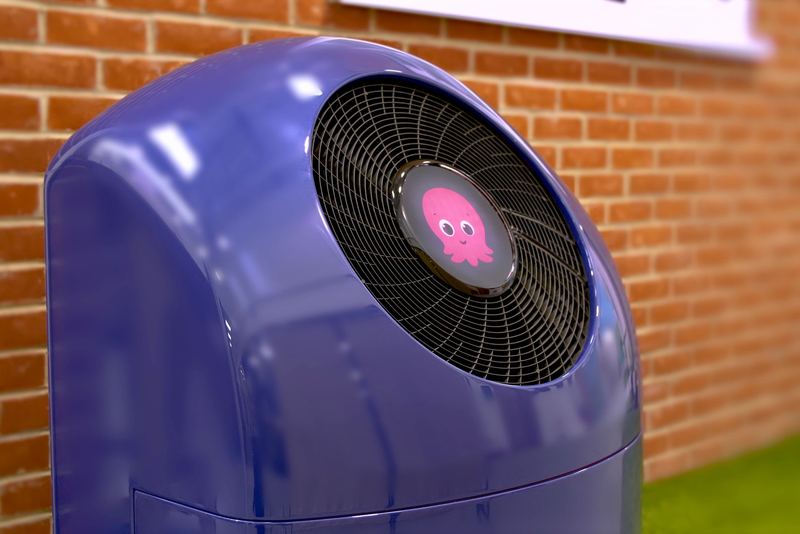
Key facts
- A heat pump produces around 3 units of heat for every unit of electricity it uses.1
- Air source heat pumps still find heat below freezing, and are designed for your area’s cold day: in London, −1.7°C or −3.0°C.1,2
- Designing for a lower flow temperature raises efficiency: Octopus’s Cosy 6 has a SCOP of 3.4 at 50°C and 2.8 at 65°C.3
- The Boiler Upgrade Scheme pays £7,500 towards an air source heat pump in England and Wales.4
On this page
Put your hand on the back of a fridge and it is warm. That warmth came out of the food inside: the fridge pumped it from the cold box into your kitchen. A heat pump does the same job pointed the other way. It takes heat out of the air in your garden, even on a frosty morning, and pumps it into your radiators and hot water.
That is the whole idea. A heat pump does not make heat by burning fuel; it moves heat that is already there. Because moving heat takes less energy than making it, a heat pump produces around 3 units of heat for every unit of electricity it uses.1
Our verdict: a heat pump is the cheapest way to heat most homes once it is designed for a low flow temperature. Designed badly, it can cost more to run than the gas boiler it replaced. The design, not the brand, decides which you get.
The refrigerant cycle, step by step
Inside the outdoor unit, a refrigerant circulates in a sealed loop. It goes through four stages, again and again.1,5
- Collect. A fan draws outside air across a heat exchanger. The refrigerant inside is colder than the air, so it absorbs heat, and as it warms it turns from a liquid into a gas.
- Compress. An electric compressor squeezes the gas. Raising the pressure raises its temperature further.
- Deliver. The hot gas passes through a second heat exchanger and hands its heat to the water in your heating system, which flows to the radiators and the hot water cylinder.
- Reset. Having given up its heat, the refrigerant cools and turns back into a liquid, ready to start again.
Electricity runs the fan, the compressor and the pumps. It does not heat the water directly, which is why the efficiency figures look so high. A heat pump heats the water for your radiators in much the same way as a gas boiler does, so it feeds radiators or underfloor heating and a hot water cylinder, though some radiators may need swapping for larger ones.1
Modern units use natural refrigerants: both the Octopus Cosy and the Vaillant aroTHERM plus use R290.3,6
Does it work when it is freezing?
Yes. There is heat energy in the air even below freezing, and an air source heat pump can use it.1 Even so, an installer designs it to cover your home’s full heat loss on a cold day for your area: in London the design outdoor temperature is −1.7°C or −3.0°C, in Glasgow −3.5°C or −5.9°C.2
An air source system should also keep the house at the design temperature through repeated defrost cycles, when the outdoor unit briefly clears ice from its coil.2
What SCOP means, and why it matters
The efficiency of a heat pump is its coefficient of performance: units of heat out for each unit of electricity in. Because that changes with the weather, the useful figure is the seasonal average, the SCOP. The higher the SCOP, the more kWh of heat you get for every kWh of electricity over a typical heating season.
The government grant sets a floor. To qualify for the Boiler Upgrade Scheme, an air-to-water heat pump must reach a SCOP of at least 2.8 as installed.4
Why flow temperature decides your bills
Flow temperature is how hot the water leaving the heat pump is. The cooler the water the pump has to make, the less work the compressor does, and the higher the SCOP. You can see the effect across the Octopus Cosy range:
| Model | SCOP, designed for a 50°C flow3 | SCOP, designed for a 65°C flow3 |
|---|---|---|
| Cosy 6 | 3.43 | 2.83 |
| Cosy 9 | 3.63 | 3.03 |
| Cosy 12 | 3.93 | 3.33 |
Turn that into money. At the capped average electricity price for October to December 2026, a SCOP of 3.4 makes heat noticeably cheaper than a SCOP of 2.8.7,3 Gas on the same cap is 7.97p per kWh; through a boiler that is about 90% efficient, each kWh of heat costs a little more than that.8,5
What a unit of heat costs, by system
Pence per kWh of heat at capped unit rates, excluding standing charges
| System | p per kWh of heat |
|---|---|
| Heat pump, SCOP 3.9 | 6.75p |
| Heat pump, SCOP 3.4 | 7.74p |
| Gas boiler, 90% efficient | 8.86p |
| Heat pump, SCOP 2.8 | 9.40p |
- Octopus Energy: Cosy heat pump Accessed 14 NOV 2026
- Ofgem: Energy price cap will rise by 4% from October 2026 Accessed 14 NOV 2026
- Ofgem: Changes to the energy price cap between 1 October and 31 December 2026 Accessed 14 NOV 2026
- British Gas: Air source heat pumps, explained Accessed 14 NOV 2026
Source: octopus.energy, ofgem.gov.uk, britishgas.co.uk · Updated 14 NOV 2026 · Download CSV
So a heat pump designed for a low flow temperature beats gas on the cost of each unit of heat, and one designed for a high flow temperature loses. The chart leaves out standing charges, which you pay either way for electricity and only if you keep a gas supply.
Lower flow temperatures need more radiator surface to deliver the same heat, which is why a heat pump survey looks hard at your radiators. The MCS design standard reflects this: if a design proposes a flow temperature above 55°C, the installer should also offer one at 55°C or lower and explain the difference in running cost, so you can choose.2
What an MCS survey checks
An installer certified by MCS works to two standards, one for design and one for installation.2,9 The design side is what protects you:
- Heat loss. A heat load calculation for the whole building, using set room temperatures: 21°C for living rooms, 18°C for bedrooms, 22°C for bathrooms.2
- Sizing. The heat pump must provide at least 100% of that heat load at the design flow temperature, without leaning on a backup electric heater.2
- Hot water. The cylinder is sized from a daily demand of 45 litres per person.2
- Written estimate. Before you sign, you get a performance estimate and the datasheets for the heat pump and cylinder in writing.2
Units come in a range of sizes to match: the aroTHERM plus, for example, is made at 3.5, 5, 7, 10 and 12 kW.6 The Cosy 6 generally suits homes of 1 to 4 bedrooms with a heat loss of less than 5.6 kW.3
Air source, ground source and air-to-air
The cycle is the same whatever the source. Heat pumps can capture heat from air, ground or water.1 The differences are where the heat comes from and where it goes.
| Type | Collects heat from | Delivers heat to | Boiler Upgrade Scheme grant |
|---|---|---|---|
| Air source (air-to-water) | Outside air | Radiators or underfloor heating, and hot water | £7,5004 |
| Ground source | Pipes buried in the ground or boreholes | Radiators or underfloor heating, and hot water | £7,5004 |
| Air-to-air | Outside air | Warm air through indoor units | £2,5004 |
An air-to-air system needs an indoor unit in every habitable room, each sized to that room’s heat loss.2 For most homes with radiators, air-to-water is the direct replacement for a boiler. A ground source grant voucher is valid for 6 months, against 3 for air source.4
Noise
A heat pump’s fan and compressor make a steady hum. The Cosy 6 has a sound power of 58 dB(A) at 55°C, and the aroTHERM plus goes as low as 54 dB(A) at a distance of 3 metres.3,6 Those two figures are measured differently, so ask installers to quote the same measure for every unit they offer. Your installer should also site the outdoor unit where it won’t bother the neighbours.9
What next
If the mechanics make sense, the next questions are cost and grant. The Boiler Upgrade Scheme pays £7,500 towards an air source heat pump in England and Wales, and the installer claims it for you.4 Read our guide to air source heat pumps for choosing a model, installing an air source heat pump for the process, and the heat pump cost guide for prices. Then test your own numbers in the heat pump running cost calculator.
Products compared

855 × 1,125 × 595 mm
Octopus Energy
Octopus Cosy 6
- Heat output
- 5.6 kW (−5 °C outside, 50 °C flow)1
- Efficiency
- SCOP 3.4 (designed at 50 °C)1
- Noise
- 58 dB(A) sound power (at 55 °C)1
- Size
- 855 × 1,125 × 595 mm1
Price: No published price
Octopus Cosy 6: Where to buy: octopus.energy
as of · octopus.energy
Show all 3 ▸
Octopus Energy
Octopus Cosy 12
- Heat output
- 11.2 kW (−5 °C outside, 50 °C flow)1
- Efficiency
- SCOP 3.9 (designed at 50 °C)1
- Noise
- 61 dB(A) sound power (at 55 °C)1
- Size
- 855 × 1,375 × 595 mm1
Price: No published price
Octopus Cosy 12: Where to buy: octopus.energy
as of · octopus.energy
Vaillant
Vaillant aroTHERM plus
- Noise
- Sound power as low as 54 dB(A); Quiet Mark (not the 10 kW model)2
Price: No published price
Vaillant aroTHERM plus: Where to buy: vaillant.co.uk
as of · vaillant.co.uk
| Product | Heat output | Efficiency | Noise | Size | Price |
|---|---|---|---|---|---|
Octopus EnergyOctopus Cosy 6 |
5.6 kW (−5 °C outside, 50 °C flow)1 | SCOP 3.4 (designed at 50 °C)1 | 58 dB(A) sound power (at 55 °C)1 | 855 × 1,125 × 595 mm1 | No published priceOctopus Cosy 6: octopus.energy |
Octopus EnergyOctopus Cosy 12 |
11.2 kW (−5 °C outside, 50 °C flow)1 | SCOP 3.9 (designed at 50 °C)1 | 61 dB(A) sound power (at 55 °C)1 | 855 × 1,375 × 595 mm1 | No published priceOctopus Cosy 12: octopus.energy |
Vaillant aroTHERM plus |
– | – | Sound power as low as 54 dB(A); Quiet Mark (not the 10 kW model)2 | – | No published priceVaillant aroTHERM plus: vaillant.co.uk |
All data
| Product | Heat output | Efficiency | Noise | Flow temperature | Refrigerant | Size | Warranty | Sizes | Energy class |
|---|---|---|---|---|---|---|---|---|---|
| Octopus Cosy 6 | 5.6 kW (−5 °C outside, 50 °C flow)1 | SCOP 3.4 (designed at 50 °C)1 | 58 dB(A) sound power (at 55 °C)1 | 70 °C max flow1 | R290 (natural refrigerant)1 | 855 × 1,125 × 595 mm1 | 8 years1 | – | – |
| Octopus Cosy 12 | 11.2 kW (−5 °C outside, 50 °C flow)1 | SCOP 3.9 (designed at 50 °C)1 | 61 dB(A) sound power (at 55 °C)1 | 70 °C max flow1 | R290 (natural refrigerant)1 | 855 × 1,375 × 595 mm1 | 8 years1 | – | – |
| Vaillant aroTHERM plus | – | – | Sound power as low as 54 dB(A); Quiet Mark (not the 10 kW model)2 | – | R2902 | – | 2 years, extendable to 7 through approved installers2 | 3.5, 5, 7, 10 and 12 kW2 | A+++2 |
Specifications come from each maker's own product page or datasheet, taken on 14 NOV 2026. Our picks are editorial judgement from those published specs, not test results; we haven't tested the products. – means the maker publishes no price.
Calculators
Heat pump running cost calculator
A heat pump's yearly electricity cost compared with your current heating, and the price after any grant.
Pre-filled from: Ofgem, Department for Energy Security and Net Zero
Open the calculator
Example figures · Difference a year · as of 18 November 2026 SCOP 3.4 −£76 … +£266 a year
Rules and grants in force
Boiler Upgrade Scheme
Ofgem
£7,500 as of
A grant towards replacing a fossil-fuel boiler: £7,500 for an air source or ground source heat pump, £5,000 for a biomass boiler and, since the 2026/27 scheme year, £2,500 for an air-to-air heat pump (homes only). An EPC is no longer needed. The installer applies for the grant.
Official source ofgem.gov.uk
Updated · against ofgem.gov.uk
Energy price cap, 1 October to 31 December 2026
Ofgem
26.32 p/kWh as of
Ofgem's price cap for October to December 2026 puts a typical dual-fuel bill paid by direct debit at £1,723 a year, 4% higher than the previous quarter. Electricity is capped at 26.32p per kWh with a standing charge of 54.83p a day; gas at 7.97p per kWh with a standing charge of 29.68p a day. Ofgem will announce the cap for January to March 2027 by 25 November 2026.
Official source ofgem.gov.uk · ofgem.gov.uk · ofgem.gov.uk
Updated · against ofgem.gov.uk
Dated rule changes
-
in 44 days
New energy price cap period begins Intended
Ofgem will announce by 25 November 2026 the price cap level for the period from 1 January to 31 March 2027.