Heat pumps · UK · Guide
Installing an air source heat pump: from survey to handover
Installing an air source heat pump goes well or badly long before anyone lifts the unit onto its base. Here is the sequence, what the installer must do at each stage, and what you should have in your hand at the end.
Key facts
- The installer must be MCS certified and applies for the Boiler Upgrade Scheme grant on your behalf.1
- The grant is £7,500 for an air source heat pump, or £9,000 in off-gas homes replacing oil or LPG until 31 March 2027.1,2
- Ofgem emails you to confirm consent, and you have 14 days to reply.1
- The heat pump must be sized to meet 100% of the calculated heat load.3
- Your MCS certificate must be registered within 10 working days of commissioning.3
On this page
- Step 1: find an MCS-certified installer
- Step 2: the survey and heat loss calculation
- Step 3: the written quote and pre-sale information
- Step 4: the grant application and your consent
- Step 5: telling the network operator
- Step 6: installation and commissioning
- Step 7: what you should get at handover
- What it costs
- Our verdict
Choose an MCS-certified installer registered for the Boiler Upgrade Scheme. They survey the house, size the heat pump to cover all of its heat loss, and give you a written design and performance estimate before you sign.3 They apply for the £7,500 grant, which comes off your quote, and Ofgem emails you to confirm.1 They notify your network operator, install, commission and hand over a pack of documents and an MCS certificate.4,3
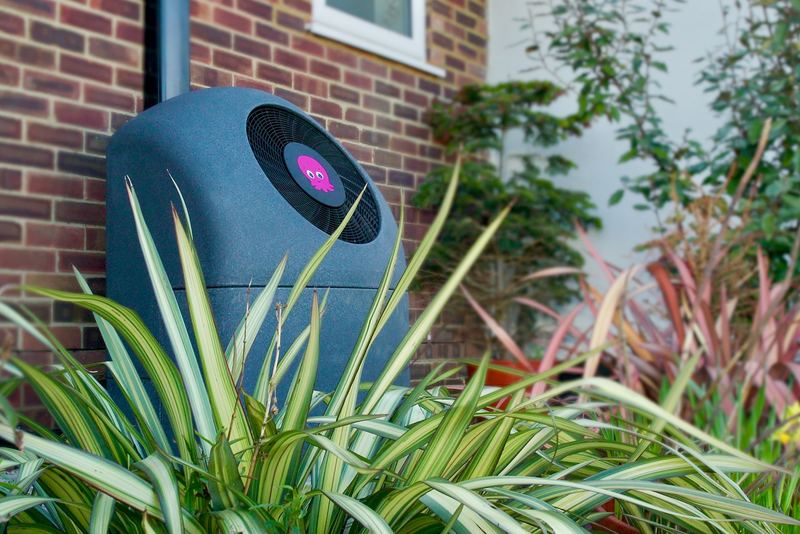
The unit on the patio is the part everyone notices, but whether you are warm in February is decided weeks before the van turns up, by a room-by-room heat loss calculation, a design flow temperature and a radiator schedule. Get those right and the rest is plumbing.
Our verdict: the cheapest quote is rarely the best one. Choose the installer whose design you understand, whose flow temperature is 55°C or lower, and who explains the running cost in writing.3
Step 1: find an MCS-certified installer
Only an MCS-certified installer can claim the Boiler Upgrade Scheme grant, and the firm must also belong to an approved consumer code: HIES, RECC or the MCS consumer code.1 The MCS search lets you look for heat pump installers near your address, filter for those registered for the BUS, and check that a firm is certified for the technology you want.5
Get at least two quotes. You will learn more from comparing two designs than from any guide.
Step 2: the survey and heat loss calculation
A proper survey ends in a heat load calculation for the building, done to the European standard BS EN 12831 using set indoor temperatures for each room and an outdoor design temperature for your area.3 The room targets are specific:
| Room | Design temperature |
|---|---|
| Living and dining rooms | 21°C3 |
| Bedrooms, hall, landing, kitchen | 18°C3 |
| Bathroom | 22°C3 |
The outdoor figure varies by place. For London, the design temperature is −1.7°C or −3.0°C depending on which column the designer uses; for Glasgow, −3.5°C or −5.9°C.3
The heat pump must then cover at least 100% of the calculated heat load at the chosen flow temperature, without relying on a backup electric heater.3 For an air source heat pump, it should hold the design temperatures through repeated defrost cycles.3 The hot water cylinder is sized from a daily demand of 45 litres for each person, counting the number of bedrooms plus one or the number of occupants, whichever is higher.3
Ask about flow temperature. Lower is more efficient. If a design proposes a flow temperature above 55°C, the installer should also give you a design at 55°C or lower, and explain the difference in efficiency and running cost so you can choose.3 That alternative may need larger radiators in some rooms. It is usually worth it: on Octopus’s Cosy 6, the seasonal efficiency falls from 3.4 when designed for 50°C to 2.8 when designed for 65°C.6
Step 3: the written quote and pre-sale information
Before you sign anything, you should receive in writing:3
- a performance estimate for the system, based on your home’s EPC where one exists;
- the manufacturer’s datasheet for the heat pump;
- the datasheet for the hot water cylinder, if one is included;
- details of any subcontractor who will carry out the installation.
The quote must show the price with the BUS grant already deducted.1 If you are in England and want to rely on permitted development rights for the outdoor unit, the installer must design to the MCS planning standard.3 They must also make sure the work is notified under the Building Regulations before they hand the system over.3
Need finance? The Warm Homes Loan scheme lets you borrow from a participating lender for the cost above the grant, up to £20,000 for an air-to-water heat pump before the grant comes off.7 Our explainer on the Warm Homes Plan covers how the loan works.
Step 4: the grant application and your consent
The Boiler Upgrade Scheme is installer-led: the installer applies on your behalf.1 Ofgem then emails you, from boiler.upgrade.scheme.ofgem@notifications.service.gov.uk, to confirm your consent. You have 14 days to click the link, or the application expires; if you have no email address, a phone and paper route gives you 28 days.1 Watch your junk folder.
Some rules that catch people out:
- No EPC needed. Since 28 April 2026 a property no longer needs a valid EPC to apply, though its number must be given if one exists.1
- What you are replacing. The old system must be fossil-fuel heating or electric heating without a heat pump, such as storage heaters or an electric boiler.1
- One grant per property, and no hybrids that keep a gas boiler alongside the heat pump.2
- Efficiency. The installed system must reach a seasonal efficiency (SCOP) of at least 2.8.1
- Timing. An air source voucher is valid for 3 months. It is safest to wait for the voucher before the system is commissioned: commissioning first is allowed, but the installer carries the risk if the voucher is then refused.1
Off the gas grid and replacing oil or LPG? The grant rises to £9,000 until 31 March 2027.8,2 Our guide to the heat pump grant covers eligibility in more depth.
Step 5: telling the network operator
The installer must make sure the heat pump is notified to your distribution network operator, and get permission in advance where needed.4 Take SSEN’s area as an example. If your supply is suitable, the installer can fit the heat pump and notify SSEN within 28 days. If the assessment shows a possible problem, they apply for a load check first, and SSEN typically replies within 10 working days.9 A supply upgrade, if needed, gets its own timetable.9
Step 6: installation and commissioning
The work itself covers the outdoor unit, pipework, any radiator changes and the cylinder. The outdoor unit should be placed to avoid nuisance to neighbours, and its condensate drained safely to a drain or soakaway.4
Commissioning follows a documented procedure that checks the system is safe, installed to the standard and running as designed.4 For the grant, commissioning means fully installed, tested and signed off to MCS standards and the manufacturer’s requirements, including every radiator in the design.1 Ask the engineer to show you the controls and how the weather compensation is set; the commissioning checklist includes a line confirming the controls were demonstrated to you.4
Step 7: what you should get at handover
This is your proof that the job was done properly. You should receive a handover pack with:3
- the commissioning forms and checklists;
- the maintenance requirements and the services available;
- the manufacturer’s manuals and warranty details;
- any documents needed for grant schemes;
- a signed declaration that the installation meets the MCS standard, a list of key components, the performance estimate and how long to leave before the first inspection.
The installer must register the installation and generate your MCS certificate within 10 working days of commissioning.3 Keep it with the house deeds; buyers and future installers will ask for it.
What it costs
Prices depend on the house. For a benchmark, Octopus Energy’s typical heat pump price was £4,064 after the £7,500 grant, the median of its post-survey quotes between June and September 2026.6 The temporary zero rate of VAT on installed heat pumps runs until 31 March 2027, and the reduced rate takes over from 1 April 2027.10 Our air source heat pump cost guide breaks the figures down, and the heat pump running cost calculator shows what you will pay to run one.
Our verdict
Judge installers by their design, not their headline price. A good one shows you the heat loss figures, offers a design at 55°C or below, puts the performance estimate in writing and talks you through the consent email before it arrives.3,1 If you are still choosing a model, start with our guide to air source heat pumps, and if the mechanics are new to you, read how a heat pump works.
Products compared

855 × 1,125 × 595 mm
Octopus Energy
Octopus Cosy 6
- Heat output
- 5.6 kW (−5 °C outside, 50 °C flow)1
- Efficiency
- SCOP 3.4 (designed at 50 °C)1
- Noise
- 58 dB(A) sound power (at 55 °C)1
- Size
- 855 × 1,125 × 595 mm1
Price: No published price
Octopus Cosy 6: Where to buy: octopus.energy
as of · octopus.energy
Show all 3 ▸
Octopus Energy
Octopus Cosy 12
- Heat output
- 11.2 kW (−5 °C outside, 50 °C flow)1
- Efficiency
- SCOP 3.9 (designed at 50 °C)1
- Noise
- 61 dB(A) sound power (at 55 °C)1
- Size
- 855 × 1,375 × 595 mm1
Price: No published price
Octopus Cosy 12: Where to buy: octopus.energy
as of · octopus.energy
Vaillant
Vaillant aroTHERM plus
- Noise
- Sound power as low as 54 dB(A); Quiet Mark (not the 10 kW model)2
Price: No published price
Vaillant aroTHERM plus: Where to buy: vaillant.co.uk
as of · vaillant.co.uk
| Product | Heat output | Efficiency | Noise | Size | Price |
|---|---|---|---|---|---|
Octopus EnergyOctopus Cosy 6 |
5.6 kW (−5 °C outside, 50 °C flow)1 | SCOP 3.4 (designed at 50 °C)1 | 58 dB(A) sound power (at 55 °C)1 | 855 × 1,125 × 595 mm1 | No published priceOctopus Cosy 6: octopus.energy |
Octopus EnergyOctopus Cosy 12 |
11.2 kW (−5 °C outside, 50 °C flow)1 | SCOP 3.9 (designed at 50 °C)1 | 61 dB(A) sound power (at 55 °C)1 | 855 × 1,375 × 595 mm1 | No published priceOctopus Cosy 12: octopus.energy |
Vaillant aroTHERM plus |
– | – | Sound power as low as 54 dB(A); Quiet Mark (not the 10 kW model)2 | – | No published priceVaillant aroTHERM plus: vaillant.co.uk |
All data
| Product | Heat output | Efficiency | Noise | Flow temperature | Refrigerant | Size | Warranty | Sizes | Energy class |
|---|---|---|---|---|---|---|---|---|---|
| Octopus Cosy 6 | 5.6 kW (−5 °C outside, 50 °C flow)1 | SCOP 3.4 (designed at 50 °C)1 | 58 dB(A) sound power (at 55 °C)1 | 70 °C max flow1 | R290 (natural refrigerant)1 | 855 × 1,125 × 595 mm1 | 8 years1 | – | – |
| Octopus Cosy 12 | 11.2 kW (−5 °C outside, 50 °C flow)1 | SCOP 3.9 (designed at 50 °C)1 | 61 dB(A) sound power (at 55 °C)1 | 70 °C max flow1 | R290 (natural refrigerant)1 | 855 × 1,375 × 595 mm1 | 8 years1 | – | – |
| Vaillant aroTHERM plus | – | – | Sound power as low as 54 dB(A); Quiet Mark (not the 10 kW model)2 | – | R2902 | – | 2 years, extendable to 7 through approved installers2 | 3.5, 5, 7, 10 and 12 kW2 | A+++2 |
Specifications come from each maker's own product page or datasheet, taken on 14 NOV 2026. Our picks are editorial judgement from those published specs, not test results; we haven't tested the products. – means the maker publishes no price.
Calculators
Heat pump running cost calculator
A heat pump's yearly electricity cost compared with your current heating, and the price after any grant.
Pre-filled from: Ofgem, Department for Energy Security and Net Zero
Open the calculator
Example figures · Difference a year · as of 18 November 2026 SCOP 3.4 −£76 … +£266 a year
Rules and grants in force
Boiler Upgrade Scheme
Ofgem
£7,500 as of
A grant towards replacing a fossil-fuel boiler: £7,500 for an air source or ground source heat pump, £5,000 for a biomass boiler and, since the 2026/27 scheme year, £2,500 for an air-to-air heat pump (homes only). An EPC is no longer needed. The installer applies for the grant.
Official source ofgem.gov.uk
Updated · against ofgem.gov.uk
Boiler Upgrade Scheme: £9,000 for homes replacing oil or LPG
Ofgem
£9,000 as of
Homes off the gas grid in England and Wales that replace oil or LPG heating can get £9,000 towards a heat pump. The higher amount started on 21 July 2026 and runs until 31 March 2027.
Official source ofgem.gov.uk · gov.uk · gov.uk
Updated · against ofgem.gov.uk
Temporary zero rate of VAT on installed heat pumps, solar panels and batteries
HM Revenue & Customs
0% as of
Installed energy-saving materials, including heat pumps, solar panels and batteries, have a temporary zero rate of VAT until 31 March 2027, after which the reduced rate applies.
Official source gov.uk
Updated · against gov.uk
Warm Homes Loan scheme
GOV.UK
up to £35,000 as of
Government-backed loans for home energy upgrades, offered by participating lenders to owner-occupiers and private landlords across the UK; the first consumer phase began in September 2026. A government grant to the lender reduces the interest rate on loans of three years or more. Loan caps are £15,000 for solar panels, £15,000 for a battery (on its own or with solar), £20,000 for an air-to-water heat pump and £35,000 for a ground source heat pump, the heat pump caps before the Boiler Upgrade Scheme grant is deducted. Air-to-air heat pumps cannot be financed yet, because MCS has no standard for them. Products and installers must be MCS certified.
Official source assets.publishing.service.gov.uk
Updated · against assets.publishing.service.gov.uk
Dated rule changes
-
in 133 days
£9,000 heat pump grant for oil and LPG homes ends
The higher Boiler Upgrade Scheme amount for off-gas homes in England and Wales replacing oil or LPG runs until 31 March 2027.
-
in 134 days
VAT on installed heat pumps, solar panels and batteries rises to 5%
The 0% rate on installed energy-saving materials ends on 31 March 2027; from 1 April 2027 they carry the reduced rate of 5%.